
UP/IDIA researchers open a new frontier enabled by MeerKAT and IDIA’s advanced compute infrastructure and support
Astronomers using the MeerKAT radio telescope in South Africa have discovered the most distant hydroxyl megamaser ever detected. It is located in a violently merging galaxy more than 8 billion light-years away, opening a new radio astronomy frontier.
Hydroxyl megamasers are natural “space lasers” – extremely bright radio-wavelength emissions produced when hydroxyl molecules in gas-rich, merging galaxies crash into one another. These cosmic collisions compress gas and stimulate large reservoirs of hydroxyl molecules to amplify radio emission. The physical mechanism is very similar to lasers on Earth, but operates at a much longer wavelength of light of about 18 centimetres, rather than optical light that our eyes can see. When this special radio light is exceptionally bright, it is termed a megamaser – a “cosmic beacon” that can be seen across vast stretches of the Universe.
This newly discovered system, HATLAS J142935.3–002836, is so distant that we are seeing it as it was when the Universe was less than half its present age. It is both the most distant and luminous known. In fact, it is so luminous that it warrants the classification gigamaser, instead of megamaser. Despite its distance, it produced a surprisingly strong signal, which is thanks to the combined power of MeerKAT and a phenomenon known as strong gravitational lensing, which was theorised by Einstein.
“This system is truly extraordinary,” said Dr Thato Manamela, SARAO-funded postdoctoral researcher at the University of Pretoria and lead author of the new study. “We are seeing the radio equivalent of a laser halfway across the universe. Not only that, during its journey to Earth, the radio waves are further amplified by a perfectly aligned, yet unrelated foreground galaxy. This galaxy acts as a lens, the way a water droplet on a window pane would, because its mass curves the local space-time. So we have a radio laser passing through a cosmic telescope before being detected by the powerful MeerKAT radio telescope – all together enabling a wonderfully serendipitous discovery.”
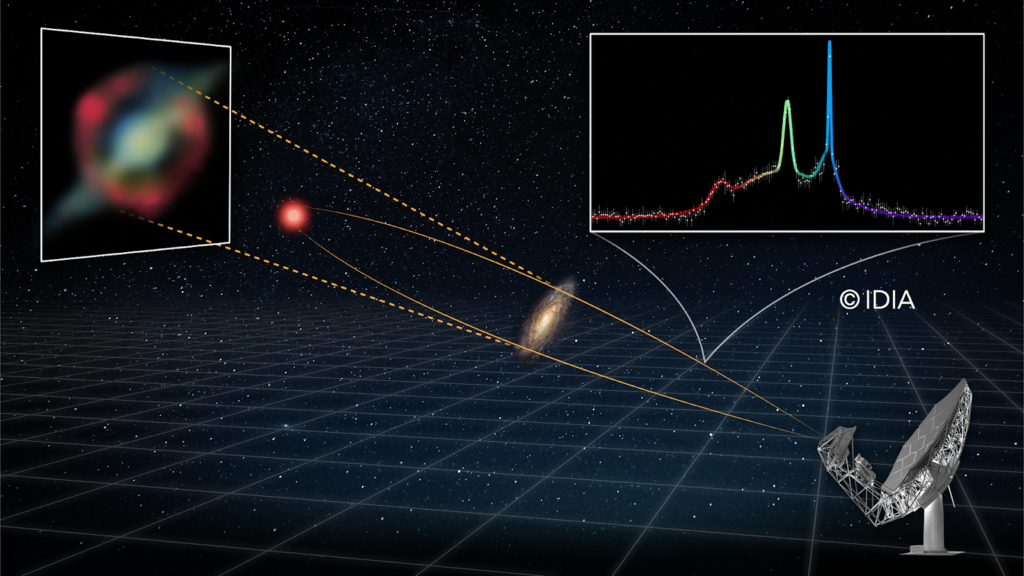
MeerKAT’s design makes it exceptionally well-suited to detect faint radio emission at centimetre wavelengths. However, collecting the data is only part of the challenge – astronomers must carefully calibrate and analyse terabytes of information (the size of a few average laptops) using sophisticated algorithms and scalable computing platforms, before any breakthrough discoveries are possible.
“This result is a powerful demonstration of what MeerKAT can do when paired with advanced computational infrastructure, fit-for-purpose data processing pipelines, and highly-trained and experienced software support personnel,” said Prof Roger Deane, co-author of the study and Director of the Inter-University Institute for Data Intensive Astronomy (IDIA), as well as Professor at the Universities of Cape Town and Pretoria. “This synergistic combination empowers young South African scientists, like Dr Manamela, to lead cutting-edge science and compete with the best in the world.”
Hydroxyl megamasers are a rare phenomenon. Previous studies showed they trace the most vigorous galaxy collisions, where enormous reservoirs of gas fuel intense starbursts and feed central black holes. Systematic searches – such as those conducted by deep MeerKAT surveys – promise to convert these once-rare finds into powerful statistical probes of cosmic evolution. The paper was accepted for publication in Monthly Notices of the Royal Astronomical Society Letters, and the pre-print can be accessed at this link.
The discovery underscores South Africa’s growing leadership in data-intensive radio astronomy. IDIA has been at the forefront of this through its design, delivery, and operation of the ilifu cloud infrastructure, as recognised by 2023/2024 NSTF-South32 4th Industrial Revolution Award. To date, IDIA has supported over 360 postgraduate students from astronomy, as well as over 130 in bioinformatics. It has nearly 500 active astronomy users in total, and has directly supported approximately 30% of all MeerKAT publications. This is only possible through the foresight and commitment of IDIA’s partners, the Universities of Cape Town, Pretoria, and the Western Cape, combined with support from the South African Radio Astronomy Observatory (SARAO).
IDIA’s Senior Operations Manager, Jeremy Smith, reflects on IDIA’s accomplishments to date: “Watching the speed with which young graduates, like Thato, grow from Honours level into leading major results like this is hugely rewarding for the IDIA Operations teams – we have to be doing a number of things correctly, together with the university supervisors and principal investigators, for that full pipeline to work.”
IDIA also supports skills development across the African continent across a broad range of disciplines, including data science, high-performance computing, and artificial intelligence. The institute is currently working to expand its support services and compute infrastructure as it prepares for the MeerKAT+ and Square Kilometre Array era, which will add significant data volume and processing complexity to current workflows.
Contact Details
For any queries, please contact admin@idia.ac.za