
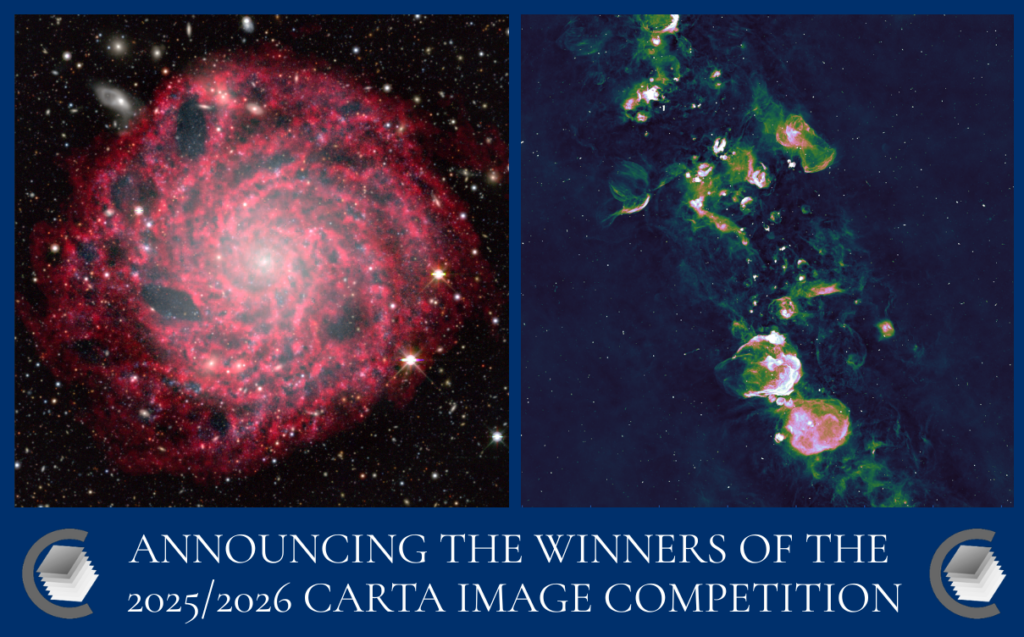
We are delighted to announce the winners of the CARTA Image Competition for 2025/2026, celebrating the creativity and scientific insight of our user community. Participants were invited to submit images that showcase the power of CARTA through two categories: multicolor blended images and general astronomical visualisations
We are thrilled to recognize our winners,
Kyra Kummer (University of Cape Town)
and
Tim Galvin (CSIRO, Australia’s national science agency),
for their outstanding submissions, which beautifully demonstrate both the scientific value and visual impact achievable with CARTA. Their work highlights not only the richness of modern astronomical data but also the versatility of CARTA as a tool for exploration and discovery. We congratulate the winners and thank all participants for joining this event.
MeerKAT View of IC 5332’s Extended HI Disk
Kyra Kummer – University of Cape Town
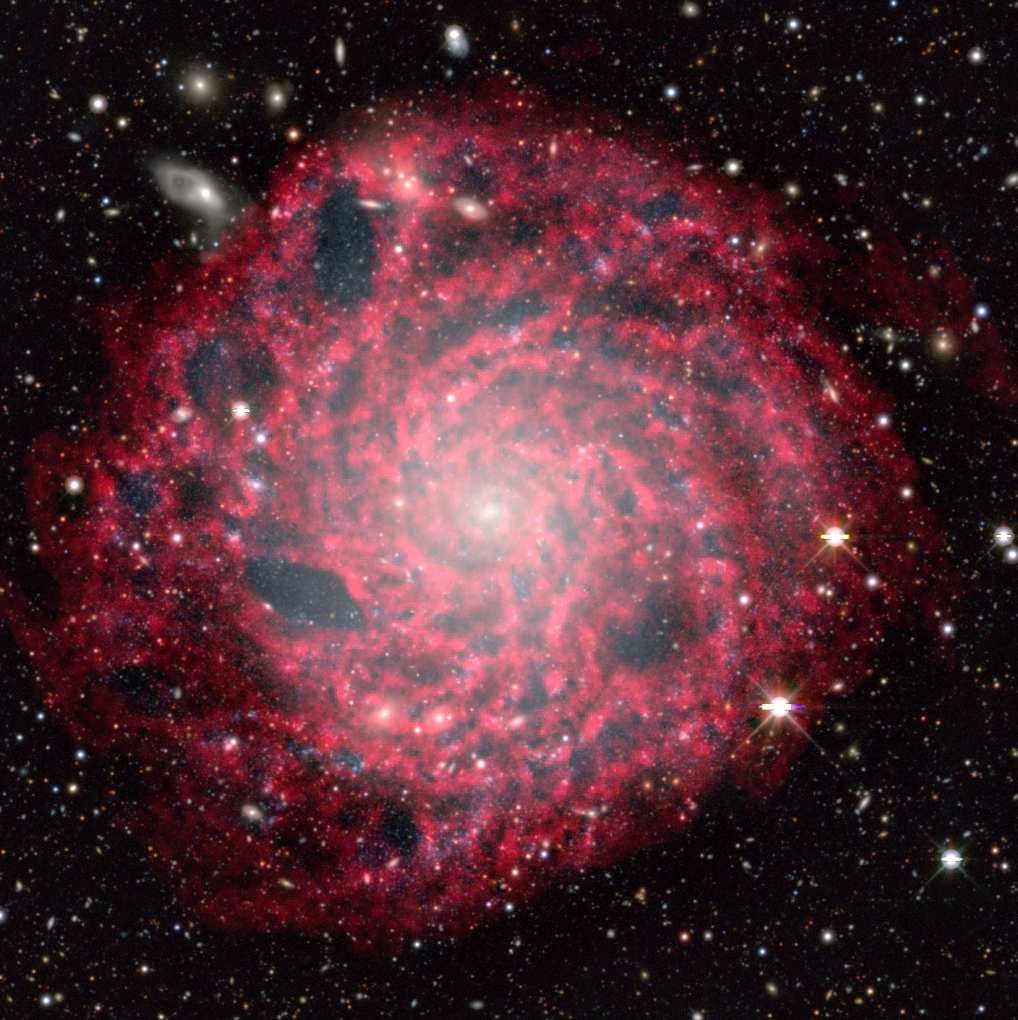
IC 5332 is a beautiful, face-on, spiral galaxy, 9.0 Mpc away from Earth. It hosts an extended ultraviolet disk, suggesting recent massive star-formation in the galactic outskirts. This image of IC 5332 combines optical images from the Legacy Survey Data Release 10 with a high-resolution (8.3”) MeerKAT L-band image of IC 5332’s neutral atomic hydrogen (HI) disk. The optical image shows emission from the twinkling stellar component of IC 5332, as well as numerous background galaxies. The HI emission — produced by the spin-flip transition of the HI atoms — is shown in crimson red, and traces IC 5332’s extended HI disk. IC 5332 is an optically faint galaxy, with an optical radius of 8.3 kpc. Its XUV and HI disks, however, reach radii of at least 15 kpc from the galactic centre. To create this image, we used CARTA’s colour-blending feature to layer three Legacy Survey optical images (g, z, and r bands) to create an RGB background image. The z-band image was assigned red, the r-band image was assigned green, and the g-band image was assigned blue. This produced a background RGB image with white, point-like stars, surrounded by a white-blue glow of starlight. The MeerKAT HI image was layered with the three optical images and assigned a crimson colour, slightly darker and pinker than the shade used for the optical z-band. IC 5332 is extremely bright in the L-band HI image; thus, we used a gamma scale on the HI image to temper the brightness of the HI emission. Each of the optical images was scaled logarithmically to enhance the appearance of the optical emission. This choice of scaling exaggerates the optical component of the galaxy to allow a clear multi-wavelength perspective of IC 5332’s spiral, star-studded structure. IC 5332 is sometimes referred to as the Corsage galaxy. In this image, it certainly appears as a cosmic rose blooming in the heavens: a glowing heart of stars, surrounded by a velvety, crimson rosette of HI gas. Image credit: K L Kummer and the PHANGS team; SARAO; CARTA
Deep Radio-Continuum Insights Towards the Galactic Plane With ASKAP
Tim Galvin – CSIRO, Australia’s national science agency
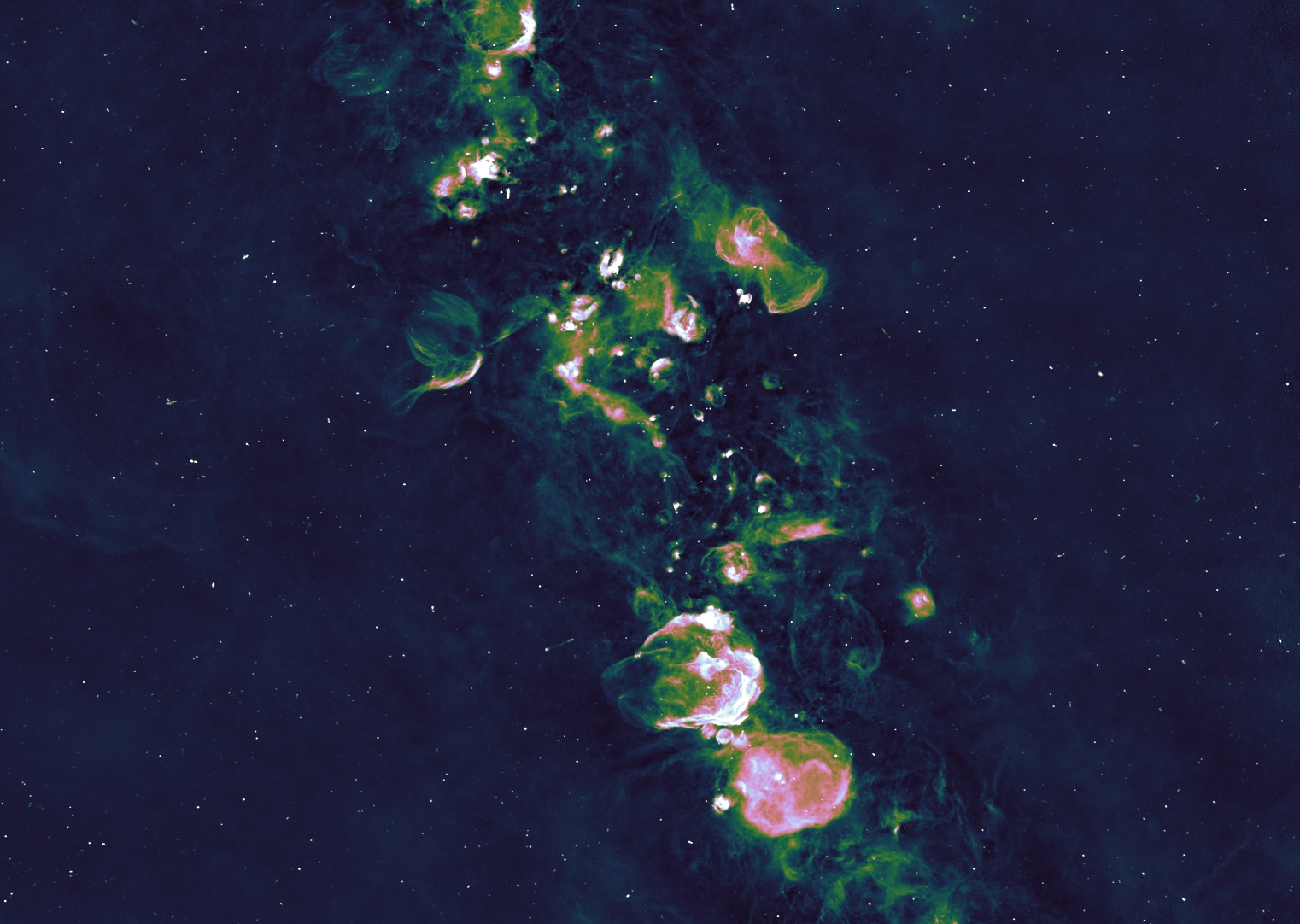
The 30 square degree field of view is enabled by the phased array feed receiver system on the ASKAP radio telescope, owned and operated by CSIRO, Australia’s national science agency. The system unlocks a wealth of potential science opportunities. In this dataset, directed towards the Galactic Center, the VAST collaboration was on the hunt for 3 long period transient objects. Over a period of 10 hours ASKAP stared towards this patch of sky, building an exquisite dataset. Imaging of the field, necessary to provide a basis of removing the static sky, was needed – a challenging task towards a field with such complexity and dynamic range. A modified version of wsclean was used in conjunction with iterative clean masking operations to slowly and carefully model the diffuse structure spanning the field. This image represents the final output of this continuum imaging procedure. Image credit: T. Galvin; ASKAP; CSIRO
About CARTA and the CARTA Image Competition
CARTA (Cube Analysis and Rendering Tool for Astronomy) is a world-leading astronomy visual analytics platform designed to address the challenges of accessing, visualising, and analysing extremely large astronomical datasets. Supporting observations from facilities including the Atacama Large Millimeter/submillimeter Array (ALMA), the Very Large Array (VLA), NRF-SARAO’s MeerKAT radio telescope, the ASKAP radio telescope, and, in future, the next-generation VLA (ngVLA) and the SKA Observatory’s (SKAO) SKA telescopes, CARTA enables researchers to work directly with massive remote data stores through a web browser. Its architecture is capable of supporting data cubes of several TB in production environments while continuing to scale to meet the growing demands of next-generation astronomy.
Since its development began in 2018, CARTA has grown through an international collaboration involving, in alphabetical order, the Academia Sinica Institute of Astronomy and Astrophysics (ASIAA), the Inter-University Institute for Data Intensive Astronomy (IDIA), the National Radio Astronomy Observatory (NRAO), and the University of Alberta Department of Physics. In 2025, the Australian SKA Regional Centre (AusSRC) joined the collaboration. Together, these partners contribute to CARTA’s management, architecture, software development, scientific features, archive integration, testing, and user support, helping establish the platform as a widely adopted tool for the global astronomy community.
The CARTA Image Competition was launched to celebrate both the scientific and artistic possibilities enabled by modern astronomy visualisation tools. The competition also provides an opportunity for users to explore new CARTA capabilities, including its multiband colour imaging features, while sharing striking visual representations of astronomical discovery with the broader community.
As of the v5.1-stable release, CARTA includes several rendering modes, including raster, contour, vector field, and multicolor blending. It supports flexible viewing layouts such as single-panel, multi-panel, and channel map views. Together with a comprehensive set of region analysis tools, CARTA supports continuum, spectral line, and polarimetry studies, as well as catalog integration for spectral lines and celestial sources. Features such as workspace management, shared workspaces, flexible layouts, and smart layouts are designed to streamline user workflows. CARTA combines memory-efficient image loading, CPU parallelization, client-side GPU-accelerated rendering, cube analysis capabilities, and large-scale catalog handling to support scientific workflows involving large and complex datasets.
Today, CARTA is used by thousands of researchers worldwide and has contributed to over 159 peer-reviewed publications. Through its open-source, browser-based architecture and international development model, CARTA is expanding access to cutting-edge astronomical research and helping scientists worldwide explore increasingly complex datasets in preparation for the data-intensive era of the SKAO and beyond.
About CARTA Partners and Affiliated Organisations
Academia Sinica Institute of Astronomy and Astrophysics (ASIAA)
ASIAA CASA Development Center (ACDC) acknowledges the grant from the National Science and Technology Council of Taiwan for the Taiwan-US Astronomical Facility Collaboration.
Website: https://www.asiaa.sinica.edu.tw/
The Inter-University Institute for Data Intensive Astronomy (IDIA)
IDIA is a partnership between the University of Cape Town, the University of the Western Cape and the University of Pretoria. Its mission is to build capacity and expertise in data-intensive research within the South African university research community, enabling leadership in MeerKAT, SKA pathfinder and future SKA science.
Website: https://www.idia.ac.za/
National Radio Astronomy Observatory (NRAO)
The NRAO is a facility of the National Science Foundation operated under cooperative agreement by Associated Universities, Inc
Website: https://public.nrao.edu/
Department of Physics, University of Alberta
The Department of Physics at the University of Alberta has contributed to the CARTA project thanks to support from the National Radio Astronomy Observatory under an ALMA Development Project and from the Canada Foundation for Innovation as part of the Canadian Initiative for Radio Astronomy Data Analysis (CIRADA).
Website: https://www.ualberta.ca/en/physics/index.html
Australian SKA Regional Centre
The Australian SKA Regional Centre (AusSRC) is a collaborative joint venture between CSIRO – Australia’s national science agency, Curtin University, the Pawsey Supercomputing Research Centre, and The University of Western Australia. AusSRC is funded by the Australian Government. As Australia’s national gateway to the international SKA Regional Centre Network (SRCNet), AusSRC plays a central role in preparing Australia for the transformational science that will be delivered by the SKA Observatory (SKAO).
Website: https://aussrc.org
The SKA Observatory (SKAO)
The SKAO is a global collaboration of member states whose mission is to build and operate cutting-edge radio telescopes to transform our understanding of the Universe, and deliver benefits to society through global collaboration and innovation. Headquartered in the UK, its two telescope arrays are being constructed in Australia and South Africa and will be the two most advanced radio telescope networks on Earth.
Website: https://www.skao.int/en
MeerKAT and NRF-SARAO
The MeerKAT telescope is operated by the South African Radio Astronomy Observatory (SARAO), a facility of the National Research Foundation (NRF), which is an agency under the Department of Science, Technology and Innovation (DSTI).
Website: https://www.sarao.ac.za/science/meerkat/
Contact Details
For any queries, please contact communications@idia.ac.za
