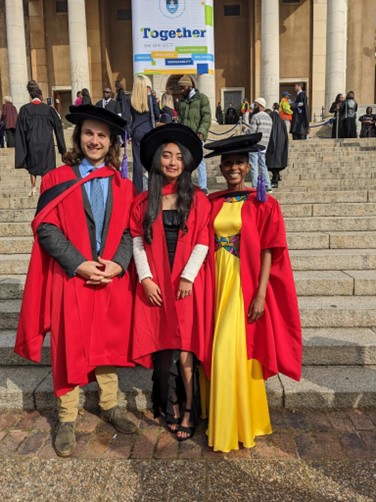
“The UCT MEGA-HI group is composed of about 18+ students (Honours, MSc, and PhD) and post-docs funded by my SARAO SARChI grant plus external collaborators. The group’s work focuses on the study of gas, particularly neutral hydrogen (HI), in and around galaxies in the local and distant universe in order to better understand how galaxies form and evolve. Over the past 3 years, the group has used the ilifu cluster to reduce and analyze data from MeerKAT open time projects and the Large Survey Projects, including MHONGOOSE, LADUMA, MIGHTEE-HI, and the MeerKAT Fornax Survey, as well as data from the Very Large Array (VLA), all combined with ancillary multi-wavelength data. This has resulted in over 20 peer-reviewed publications, four Honours dissertations, three MSc dissertations, and one PhD since 2022.”
Professor DJ Pisano, SARAO SARChI Chair, UCT.
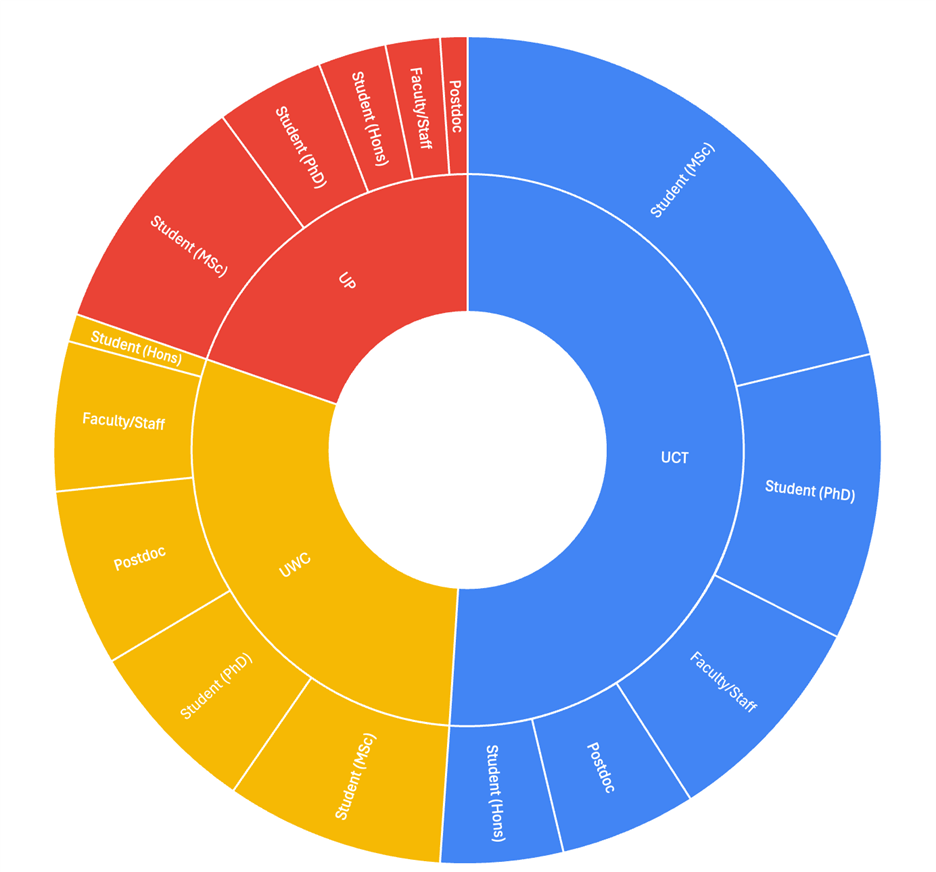
Postgraduate students are at the heart of the IDIA and ilifu community. By mid-2025, Honours, Master’s and PhD students made up just over half of ilifu’s users in both astronomy and bioinformatics, highlighting ilifu’s central role in supporting data-intensive postgraduate research. This support has become one of IDIA’s core strengths.
Through ilifu, students take ownership of complex MeerKAT datasets, working directly with supported pipelines and visualisation tools. Many of these student-led projects have produced scientific results that are featured in the 2020 – 2024 IDIA Activity Report.
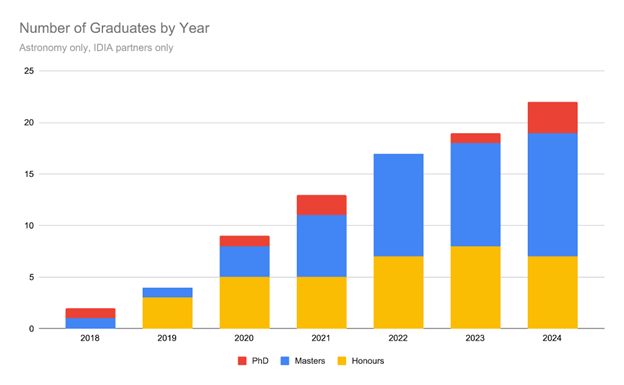
The impact of ilifu is reflected in student success. By mid-2025, nearly half of the students working on ilifu at IDIA partner universities had completed their postgraduate research. Graduates go on to a range of pathways, including PhD study and careers as data scientists or software developers in industry or at research institutes such as SARAO and IDIA, drawing on skills that transfer well beyond academia.
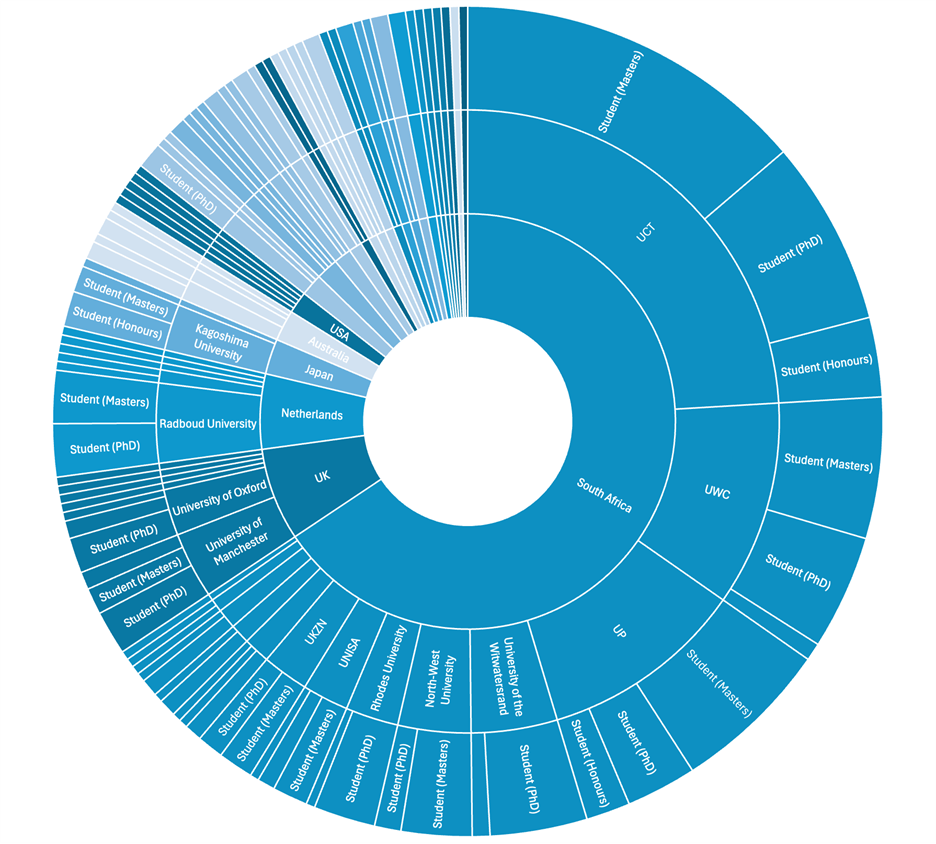
ilifu also supports a diverse and international postgraduate community. Among South African students who shared demographic information during a recent account renewal campaign, the community reflects a broad mix of gender and racial backgrounds. While support is limited to South African-led MeerKAT projects, these collaborations are often international, allowing students from around the world to benefit from access to ilifu.
This global engagement helps build an international network of ilifu alumni who act as ambassadors for the platform, while South African students form strong peer connections within the wider SKA community.
Read more about these student’s incredible achievements in the 2020 – 2024 IDIA Activity Report and click here to learn about IDIA’s Scholarship Programme.
| 2018-2024 | Data-Intensive Astronomy | Bioinformatics | ||||
|---|---|---|---|---|---|---|
| Total | Graduated* | PhD | MSc | Hons | Total | |
| UCT | 94 | 50 | 23 | 48 | 23 | 69 |
| UWC | 39 | 16 | 14 | 22 | 3 | 15 |
| UP | 45 | 22 | 10 | 23 | 12 | – |
| Other South Africa | 65 | 17 | 28 | 30 | 7 | 36 |
| Other Africa | 10 | 4 | 5 | 5 | – | 13 |
| Other International | 107 | 39 | 72 | 23 | 12 | 2 |
| Total | 360 | 148 | 152 | 151 | 57 | 135 |
Graduated*: covers the period of 2018-2024 and includes PhD, MSc and Hons students.Other South Africa (Astronomy): NWU (11), RU (11), SAAO (3), SU (5), UFS (4), UJ (1), UNISA (6), UKZN (6), UNIVEN (3), Wits (15). Other Africa (Astronomy): Ethiopia (2), Mauritius (2), Madagascar (2), Kenya (2), Benin (1), Zambia (1). Other International (Astronomy): Australia (11), Canada (3), China (5), France (3), Germany (7), India (3), Israel (2), Italy (6), Japan (9), Netherlands (19), New Zealand (1), Spain (3), Sweden (1), UK (26), USA (8). Other South Africa (Bioinformatics): CPUT (2), RU (2), SAMRC (1), SANBI (1), SPU (1), SU (25), UJ (1), UFS (2), Wits (1). Other Africa (Bioinformatics): Botswana (1), Ghana (3), Kenya (1), Mauritius (1), Morocco (1), Nigeria (4), Uganda (2). Other International (Bioinformatics): USA (2) Credit: 2020 – 2024 IDIA Activity Report